
On the subject of William Blake and expectations
March 3, 2024
Hi everyone, welcome back to the newsletter. First things first: if you’re reading this in your email, I’d highly recommend you use the WordPress Reader (in the top right corner, at least in Gmail) because some of the formatting and external links don’t look quite right, and I’m not very savvy with this yet. Anyway—
A couple weeks ago I released a new song—or, technically, a third of a song—called “Song on the End of the World, Part I”. If you haven’t heard it yet, or want to hear it again, you’re in luck, because I’ll post it here too:
Monday I shared a lyric video, which was, theoretically, supposed to make the song a little less opaque. “Song” is outside my normal wheelhouse as a songwriter; and when I write without the beats of a traditional narrative, I often find myself obfuscating more than I intend. That would be great if I were the type of songwriter who liked to resist interpretation, but I’m not. So in this post I’ll be talking mostly about “Song”‘s conception and the text that inspired it.
I don’t remember how I came across William Blake’s prophetic books specifically. I remember my first exposure to Blake’s writing, though, at 6 or 7 (or younger?) in a piece called “Lullaby” by Loreena McKennitt, a Canadian Celtic artist. The monologue toward the end of this track, from an unfinished and unpublished play, had me absolutely spellbound every time I heard it. (I even ended up borrowing the opening lines for a song called “Fling Wide the Gates” a few years ago.) Since then I’ve enjoyed every Blake piece I’ve encountered, for all their brooding theatrics.
Blake (1757–1827) was underappreciated in his lifetime; his prophetic books especially were largely dismissed by contemporary critics and publishers. His lyric poetry was more successful (in collections like Songs of Innocence and Songs of Experience), as it had a markedly different tone, and so didn’t share the stigma of his other writing. It has only been in the last century that more attention has been given to his denser, more ambitious works.
Maybe one reason Blake wasn’t so popular with the 18th century milieu was his startlingly forward-thinking stances: an anti-monarchist, an abolitionist, a proto-feminist, a critic of the Industrial Revolution—he was a revolutionary in nearly every sense of the word. While his politics weren’t totally absent from his lyric poems, his longer works gave him far more canvas with which to illustrate his points.
Beginning around 1789, Blake began publishing what would become known as his “prophetic books”. Prophecy, as Blake interpreted it, was not meant to tell the future, but to reveal some societal truth. Enamored with the American and French Revolutions, in 1793 and ’94, he published “America a Prophecy” and “Europe a Prophecy”, which inserted the conflicts into the mythology he had been expanding since 1789.
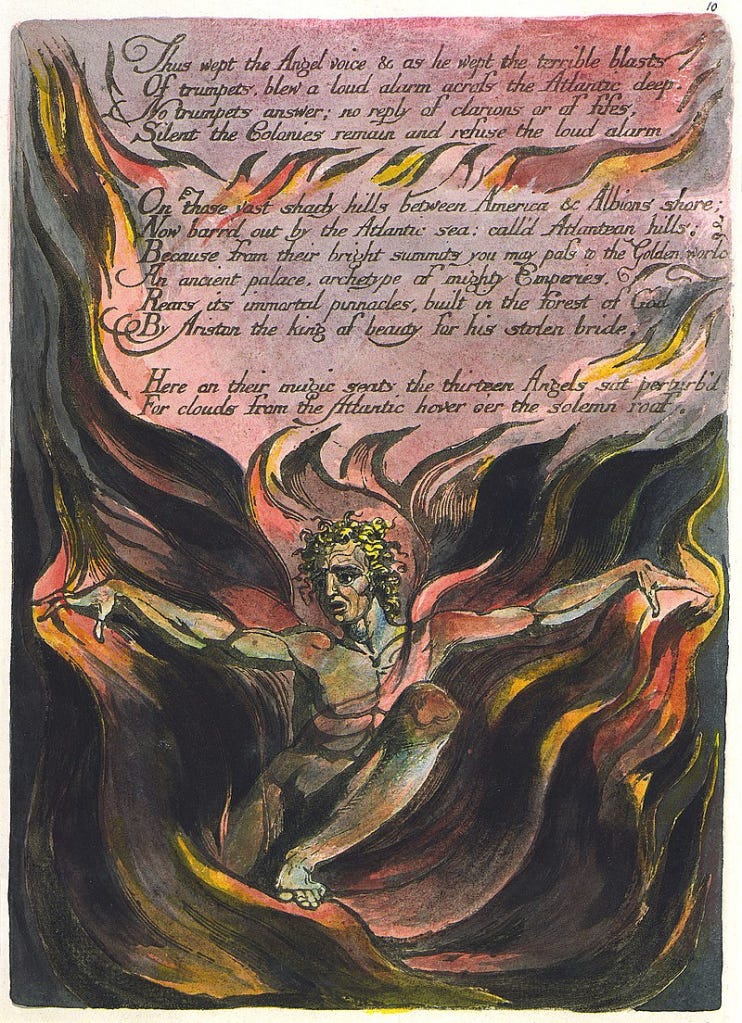
“Song on the End of the World”, for its first and third parts, takes imagery and themes from “America a Prophecy”. The poem opens with the King of England threatening America with violence and bondage. In an impassioned speech to his fellow revolutionaries, George Washington responds, summoning Orc, the personification of rebellion. Orc then goes to Britain’s shores to antagonize Albion’s Angel. (Albion, who doesn’t make an appearance in this poem, was Blake’s version of the primeval man, whose fall from grace sets into motion all of the events of human history. The name Albion was taken from an antiquated name for Britain.) Wracked with fear, the Angel calls across the Atlantic to the thirteen colonies; but rather than sympathy, the colonies’ Angels respond with anger:
“What God is he writes laws of peace, and clothes him in a tempest?
What pitying Angel lusts for tears, and fans himself with sighs?
What crawling villain preaches abstinence and wraps himself
In fat of lambs?”
As we all know, the Americans win the ensuing war, and the poem ends with something like a cliffhanger, as Orc turns to France.
Blake believed America would be a haven for equity, and gave his full-throated support to the American revolutionaries, risking imprisonment and even death by England’s draconian sedition laws. This wasn’t the first time Blake had written about his hopes for the Americans either; in Visions of the Daughters of Albion (1792), he wrote of America being a land where all races will live harmoniously, and women will win sexual liberty.
Both the American and French Revolutions were a massive disappointment for Blake. Having thrown down the chains of monarchy in 1789, by 1794 France had descended into chaos that would ultimately hand its reins back to an opportunistic autocrat. In Blake’s remaining years, America, having shaken itself free of British colonialism, would fail to dispel the institution of slavery, continue the subjugation of its native peoples, and embrace a mercantilist society which would forsake its lower classes.
With the benefit of hindsight, I approached “Song on the End of the World” as a reprimand toward the mythological America, which after winning its independence had betrayed its ideals and tarnished its legacy. For the first part of the song, I put together a lyric video (above), and included several lines of Blake’s original prophetic poem, which I hope give some context to my interpretations.
Writing the music was considerably easier than paring down and interpreting Blake’s poetry. In fact, the main four-note verse motif came from an improvisation. Often when I’m feeling stuck creatively—as I was in 2021 when this was written—I’ll just improvise for awhile and record it. This particular day in July 2021 I recorded about 9 minutes of ideas—mostly vamps while I thought of where else to go—including this one which became the melody for “End of the World”.
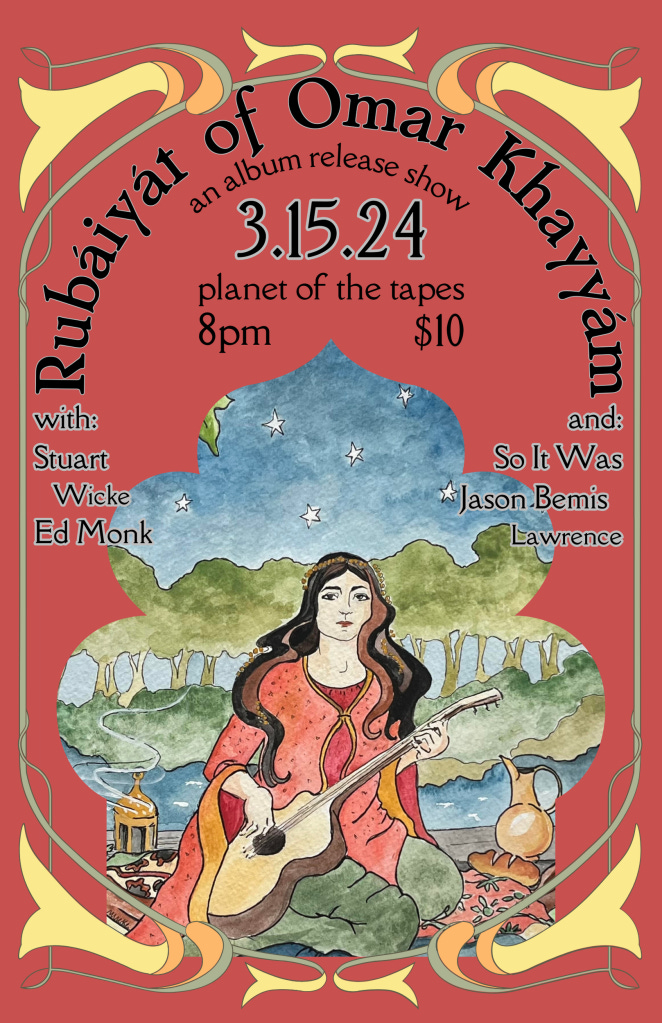
The whole song (which has two more parts) will be available everywhere on March 11 along with the rest of the new record Rubaiyat of Omar Khayyam; and to celebrate its release, we’ll be playing a show at Planet of the Tapes on Friday, March 15. I hope you can make it!
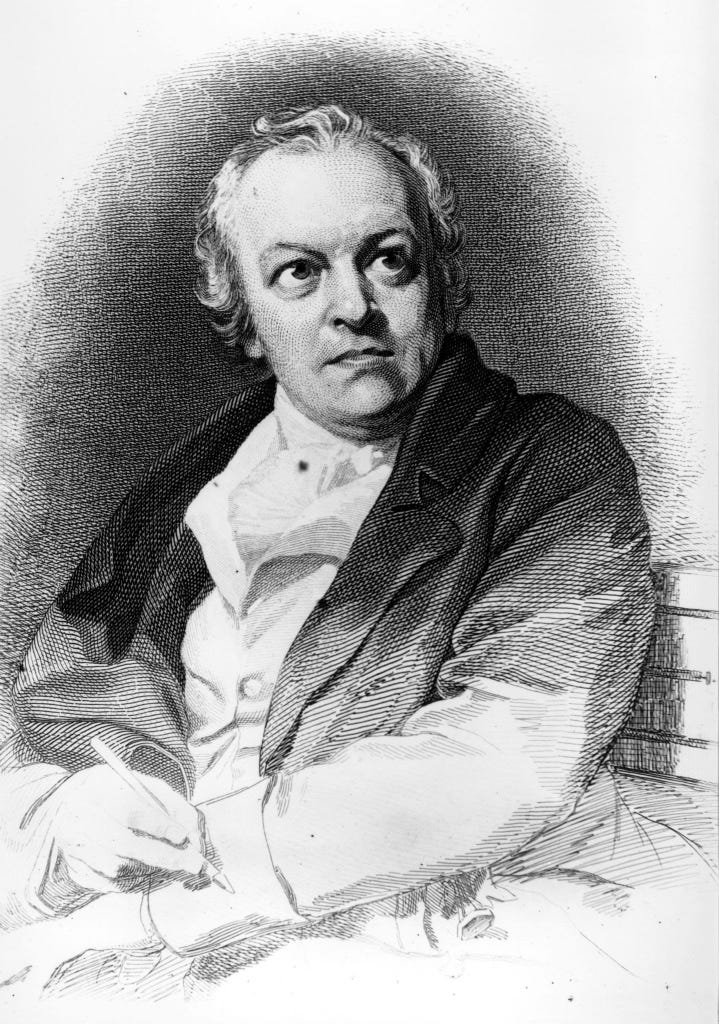
Images: Orc rising from the fires (Plate 12 from America a Prophecy), William Blake (1793); Portrait of William Blake, Luigi Schiavonetti, after Thomas Phillips, etching (1808); flyer with Rubaiyat illustration by Meg Wicke (2024).