
On the subject of Omar Khayyám and identity
April 7, 2024
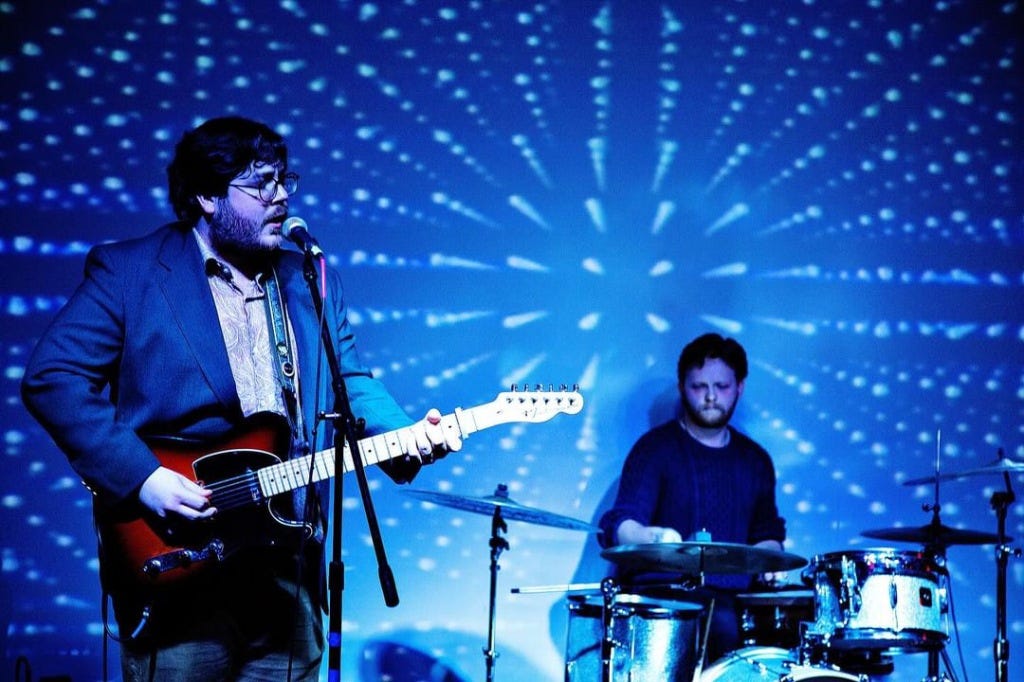
Early last month I celebrated the release of Rubáiyát of Omar Khayyám, an unrepentant progressive rock album, alongside some of Louisville’s finest musicians at Planet of the Tapes. I had the pleasure of pulling a double shift that night actually—in addition to my own set, I played bass with Jason Bemis Lawrence, who’s gearing up for his own record release very soon. We were also joined on stage by Ed Monk and So It Was, two phenomenal local acts who kept the energy high and the vibes immaculate. (Photo by Amber Thieneman)
I’ve said it countless times, but it always bears repeating; to everyone who played, attended, listened, a tremendous thank you. This post is a little all over the map, but I want to give background not only on the historical context of Rubáiyat (as I did with Song on the End of the World last month), but also some of my own experience working on it, since it was such an undertaking outside of my typical oeuvre (is that pretentious? Am I allowed to have an oeuvre?).
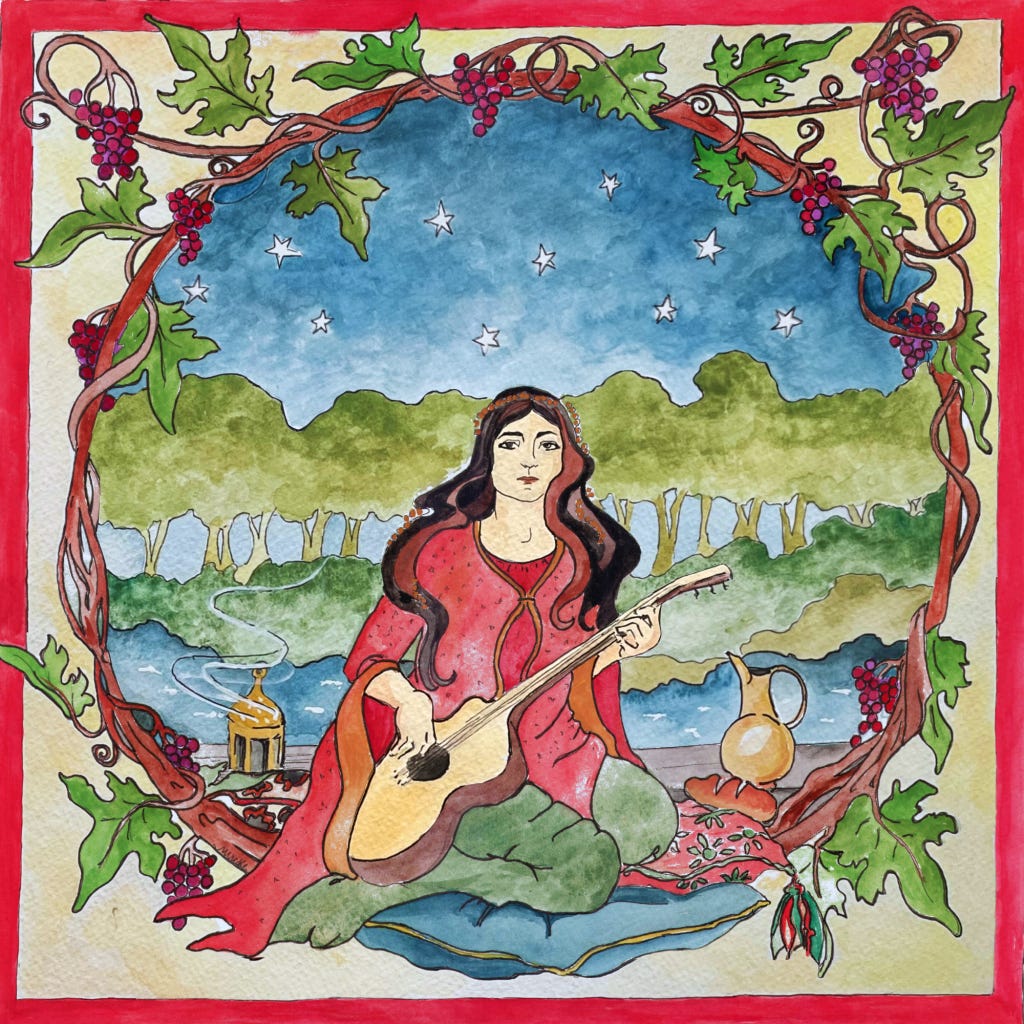
Rubá (as I’ve affectionately been referring to it in file names) had been collecting dust on my hard drive since 2021. Since recording it, I’ve prioritized releasing two other albums, We Never Had Tomorrow Anyway (2022) and Still Life (2023), on the grounds that they were more “in-character” for me. This is something I’ve struggled with for years—I often find myself trying to shoehorn in whichever sound I’m trying to embody at the time, whether it’s what the song calls for or not.
While studying jazz at U of L, I actively resisted the influence of Bill Frisell, Esperanza Spalding, Charles Mingus, or whoever else, hoping to maintain some credibility as the folk singer/songwriter I wanted to be. Despite my best efforts, the (in my mind) deliberately folk-rock Run for Help (2018) was later described to me as “jazz-infused yacht-rock”. (Thankfully I was far enough removed from the album by then to appreciate that comment.) Best laid plans, et cetera. So in an effort to stop resisting my own interests, I decided to finally get Rubá off my computer and into the world.
Rubáiyát is something of a return to form actually—I’ve always had a penchant for progressive rock, having been trained at 14 on David Gilmour solos and John Petrucci riffs. For this project though I was drawn to a more acoustic palette, like the Moody Blues, or Renaissance, or the Decemberists (whose prog credibility I feel is criminally underrated). In fact the whole project probably wouldn’t have happened were it not for the Decemberists’ 2021 livestream concerts, which lit a fire under me that spring.
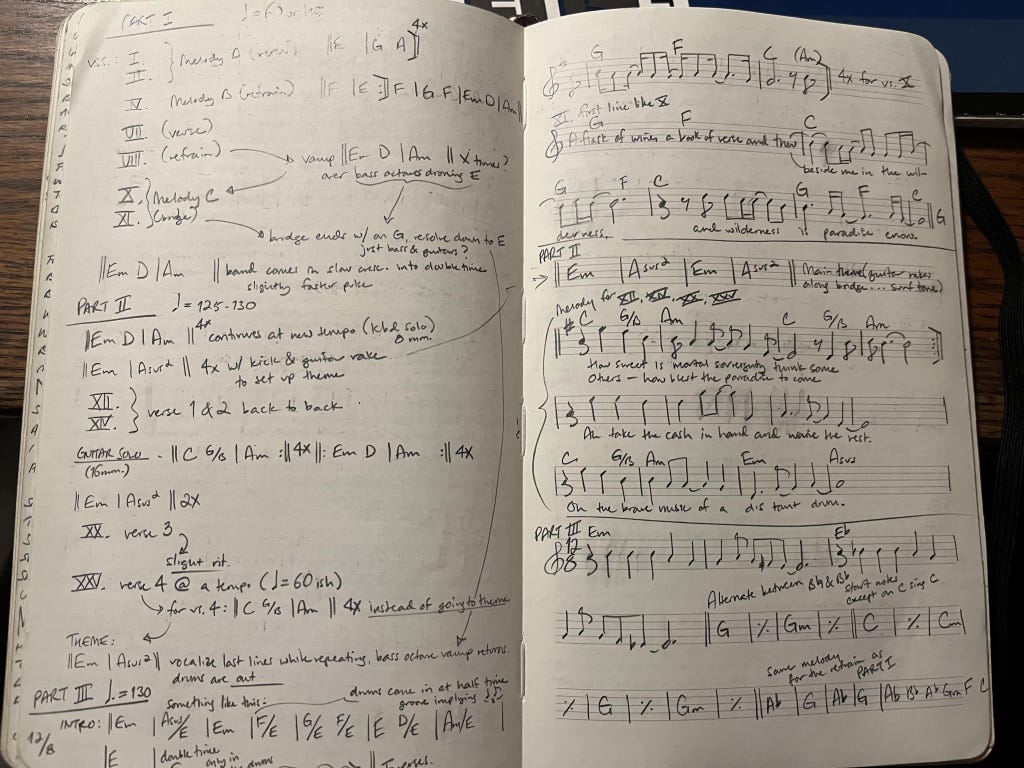
I spent several months afterward trying to write something adequately progressive, but failing for two reasons: first, my songs have historically been more intimate and narratively focused, and something about prog-rock necessitated a higher-concept piece of writing that I wasn’t able to visualize; and second, even if I had been able to write, given the state of the world in early 2021, there was very little happening in the day-to-day to inspire me.
Enter Rubáiyát of Omar Khayyám by way of the Half Price Books on Westport Road.
Ruba’i is a form of poetry from medieval Persia—essentially quatrains (stanzas of four lines), rhyming in AAAA or AABA scheme—derived from an earlier Arabic form which took hold in Iran thanks to the Muslim conquest. Rubáiyát (the plural form of ruba’i) were written most often as standalone poems. The Rubáiyát of Omar Khayyám is a collection of these poems by Omar Khayyám (1048–1131), a Persian astronomer, set in poetic translation by Edward FitzGerald (1809–1882) as a single cohesive work of 75 (or, in some editions, 110) English stanzas.
[Khayyám] evolved a concept of life which was basically mystic: he preached the moral purity of the contemplative life; he struggled to master the eternal, the good, the beautiful. And he set down his newly found convictions in a series of quatrains.
That’s what the foreword of the 1976 Easton Press edition told me anyway, and I was transfixed. I wasted little time setting the poem to music, but I wanted to know more about Khayyám, whose existential struggles resonated so clearly in the modern world—especially with the uncertainties which abounded in the thick of the pandemic.
In digging just below the surface, I determined that the truth was far more complicated.
Scholarship on Persian literature has, since 1976, split into two camps. One maintains that Omar Khayyám certainly didn’t write most of the poetry attributed to him; the other maintains he didn’t write any of it. This isn’t like the Shakespeare-isn’t-real conspiracy: Khayyám was a real person who lived and died in Nishapur, Iran in the eleventh and twelfth century. He was an esteemed and accomplished mathematician, astronomer, and scientist; he was well-traveled and employed by impressive patrons, working for the king’s treasury in Samarkand, establishing an observatory in Isfahan for the Seljuk Sultan. (In his time in Isfahan Khayyám is credited with devising the Jalali calendar, a solar calendar still used in Iran—and more accurate than the Gregorian calendar used in nearly every other country.)
Whether you are in the first or second camp, what seems to be consensus is that the first publication of any poetry attributed to Khayyám was, at the earliest, decades after his death. As both a renowned contributor to his field and a ranked member of the Sultan’s court, Khayyám enjoyed a certain level of fame, enough that biographers were tasked with documenting his life and achievements. Yet it wasn’t until at least 1160 that any of his poems surfaced in publication.
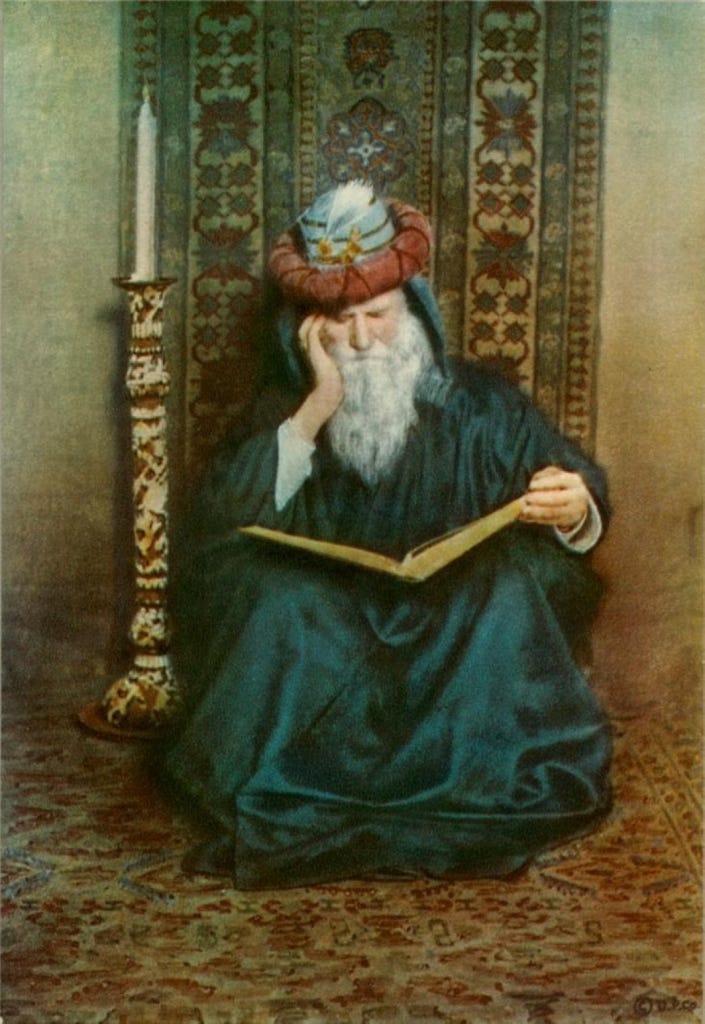
At his post, Khayyam also would have enjoyed a certain level of comfort—one that feels in direct conflict with the bawdry stanzas reveling in lower-class pleasures. So if Khayyám was not the author of this poetry, who was—and what good did it do them to misattribute it?
The Rubáiyát contained ideas which were challenging to the beliefs of Muslim Iran in the Middle Ages. Thus, to attach one’s own name to these poems was to risk censure, imprisonment, exile, or death. Edward FitzGerald’s Rubaiyat conveyed a sense of indifference toward the afterlife, and encouraged pursuits of worldly pleasure. Certainly that would have been a scandalous way to live at the time, and questions around Khayyám’s own religiosity have fueled debate since the poem’s first publication in English; but that likely wasn’t the author’s (or authors’) intent.
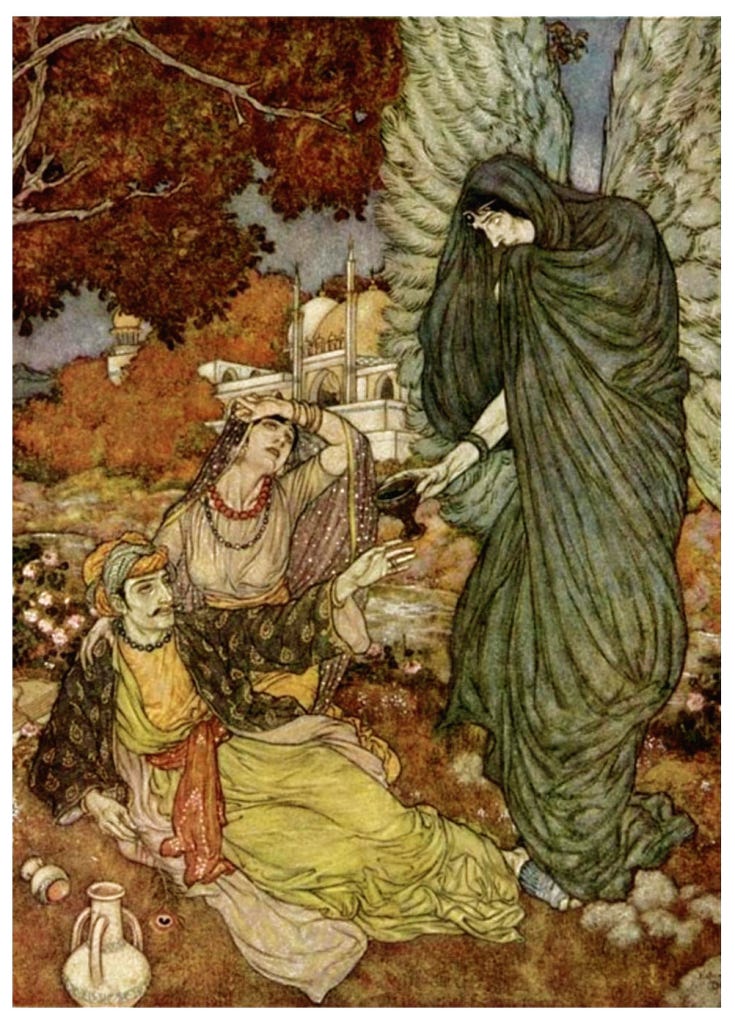
Scholars of Middle Eastern mysticism and esotericism believe that Khayyám’s poetry was full of symbolism which would have been recognizable only to those looking for it. They assert that the poem’s contributors were most likely involved in taboo practices, especially alchemy and other “magical” pursuits—things that would have been equally, or more, scandalizing to the wrong audience. Symbols like wine, grapes, and clay, which are ubiquitous throughout the poem could refer to alchemical processes or materials, conveying theories or instructions to those in the know.
I don’t know what exactly was being instructed in these poems, though I’m sure someone has figured it out. What I do know is that all of this context, except for a vague sheen of mysticism, was lost on the English-speaking audience in the 19th century. But that doesn’t answer the main question: why Khayyám?
The advances in the Islamic Golden Age were made with the support of the theocratic governments of the time. Massive efforts were made by the Sultans, Emirs, and Caliphs of the Middle Ages to establish academies, foster innovation, translate scientific texts, and assimilate technological advances from all over the world. Yet scientists, the ones responsible for unraveling the mysteries of God’s creation, developed a popular reputation for being skeptics. With a perceived disposition to secularity, noted scientists provided perfect pseudonyms for writers looking to disseminate risky ideas.
It’s supposed that Omar Khayyám had hundreds of poems attributed to him between the 12th and 15th centuries by dozens of authors. Each of these espoused their own ideas, often contradictory to those preceding them, leading to a body of work that resisted any single interpretation.
Of course I didn’t know any of this when I started working on the record. I was simply moved by the words.
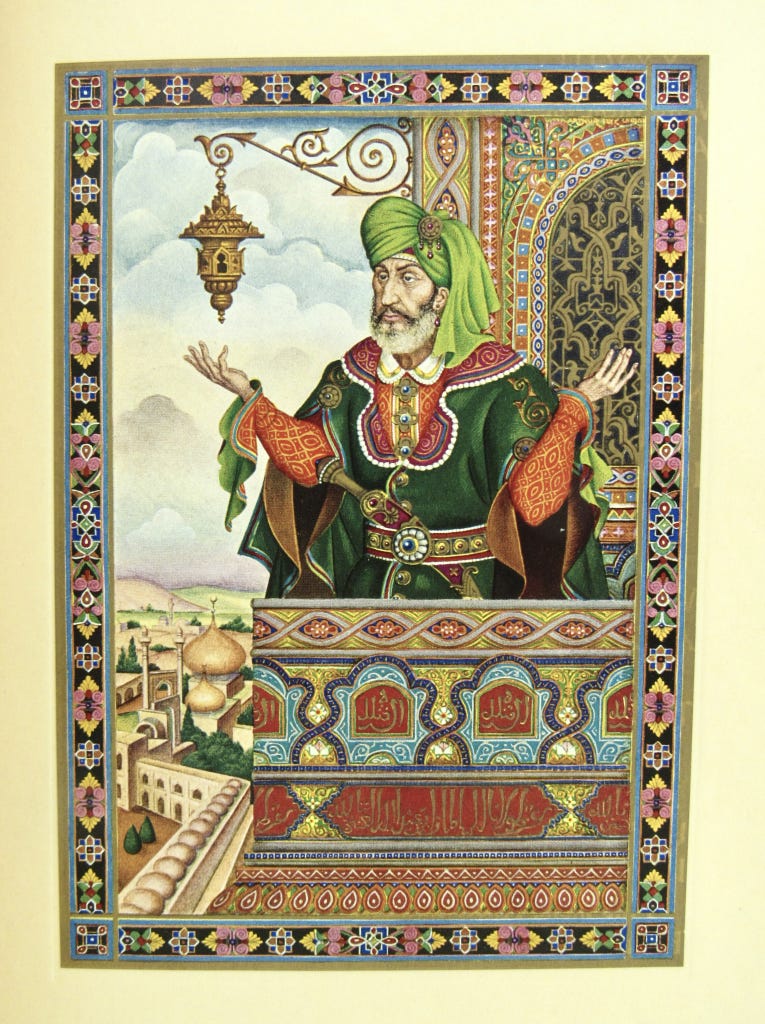
At the time I started recording I didn’t really have a plan to release any of this music; it was something of a passion project. By not immediately attaching Rubá to my self-perception, I was able to let go of preconceived notions about how I should write the music. When I started playing parts of the song on livestreams in 2022, I was surprised by the positive reaction, and since then it’s become sort of a setlist staple—I really love playing it, and so far people seem to enjoy hearing it.
There’s plenty more to say about this piece but I’ll wrap it up for now. This post was starting to approach 3000 words, so I decided to split it roughly in half—next time I’ll be talking about the influence of the Rubáiyát on the English-speaking world after its first publication in 1859. Until then, come see us one last time before I become a parent. Scott and I will be playing at Holsopple Brewing on Friday April 12 from 7-10pm. And it’s free!
(And if you’re not subscribed but want to see more like this…)
Images: SWB at Planet of the Tapes 3/15/24 (Amber Thieneman); Rubáiyát album cover (Meg Wicke); notebook excerpt (my own); Omar Khayyám illustration (Adelaide Hanscom Leeson, c. 1905); Rubáiyát illustration (Edmund Dulac, 1909); Rubáiyát illustration (Arthur Szyk, 1940).